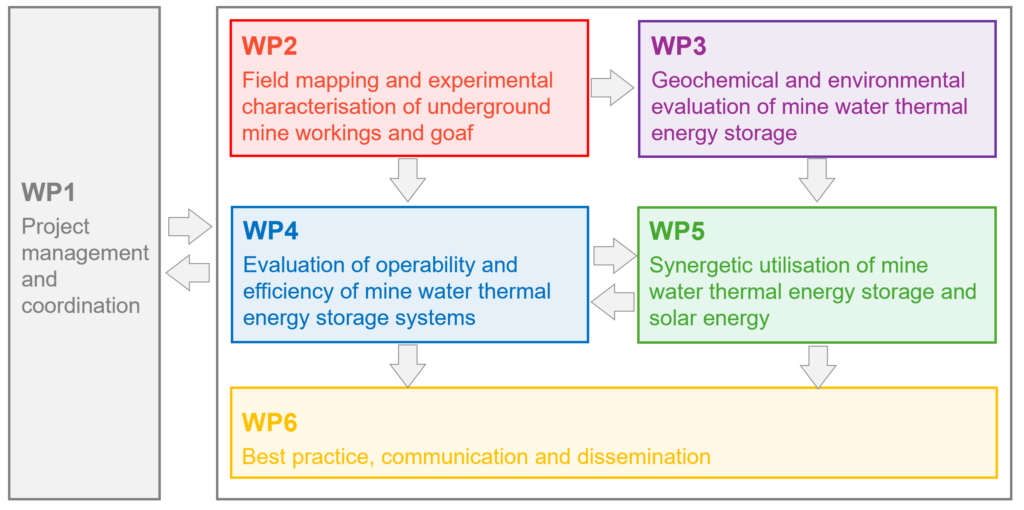
GeoSolar is structured into four technical work packages (WPs) that integrate field investigations, laboratory experiments, numerical modelling, and system integration. These are complemented by two additional WPs dedicated to project management and dissemination.
WP1. Project management and coordination
WP1 ensures the smooth, efficient, and compliant implementation of the GeoSolar project. It covers administrative, financial, legal, and technical coordination across all partners, guaranteeing that the project progresses according to plan and meets RFCS requirements.
WP2. Field mapping and experimental characterization of underground mine workings and goaf at selected end-of life coal mines
WP2 aims to identify and characterize underground mine workings and goaf areas suitable for deploying mine water thermal energy storage systems, as well as to ensure the safety of storage operations through mine water rebound monitoring, prediction and management. Underground mine workings and goaf areas at the two selected coal mines will be mapped out, and thermo-hydro-mechanical properties of goaf rocks will be experimentally characterized. Groundwater and mine water level monitoring, as well as hydrological measurements, will be carried out to inform the post-closure mine water rebound prediction and management. Results from this work package will feed into WP3 for mine water quality monitoring and assessment, and WP4 for mine water flow and heat storage dynamics modelling.
WP3. Geochemical and environmental evaluation of mine water thermal energy storage
WP3 aims to monitor, assess, and model mine water geochemistry at the two coal mines proposed for high-temperature mine water thermal energy storage systems. Geochemical assessment of mine water will be performed based upon both archived monitoring data from mine workings, pumping stations, and drainage wells, and data acquired from a tailored mine water sampling campaign at both coal mines. Hydrological and geochemical modelling of mine water thermal energy storage scenarios relevant to changing chemistry will be further carried out, which will be used to evaluate ochre clogging and scaling risks at hot wells, and to develop techniques to prevent corrosion and incrustation. Results from WP3 will feed into coupled thermo-hydro-mechanical (THM) modelling tasks in WP4, and provide essential information for developing the Geothermal Mine Water Knowledge HUB in WP6.
WP4. Evaluation of operability and efficiency of mine water thermal energy storage systems
WP4 aims at evaluating the operability and efficiency of mine water thermal energy storage systems. This will be performed through developing a novel fully-coupled THM modelling methodology capable of simulating combined Navier-Stokes and Darcy’s mine water flow and heat storage dynamics in mine goaf and underground workings. This modelling methodology will be applied to simulate the behavior of mine goaf and underground workings in response to seasonal mine water thermal energy storage and recovery in realistic post closure environments, and to identify key geological and operational factors affecting the performance of coupled mine water geothermal and solar energy storage. Additionally, the optimal multi-doublet configurations for regional implementation of mine water thermal energy storage will be identified based on the model results. WP4 will make use of the mapped layout of underground mining workings and characterized thermo-hydro-mechanical properties of mine goaf from WP2 and geochemical evaluation results of mine water from WP3, and provide results and input towards WP5 and WP6.
WP5. Synergetic utilization of mine water thermal energy and solar energy
WP5 aims to integrate and optimize coupled mine water geothermal and solar energy storage systems for district heating, and enhance the overall efficiency and sustainability of energy utilisation. The mine water thermal energy storage loop and solar energy installations will first be integrated, and then the integration between the coupled system and the district heat network will be achieved with optimized heat demand and supply management. Life Cycle and Technoeconomic assessment of the coupled system will be performed to evaluate its long-term viability, environmental impact, and economic feasibility. This task will also assess the societal impact of the coupled energy storage system, and ensure public engagement regarding the deployment of the coupled energy storage system and sustainable development of district heating systems. WP5 will make use of research outcomes from WPs 2-4 for effective system integration, and provide essential information to WP6 for the best practice and guideline development, and communication and dissemination activities.
WP6. Best practice, communication and dissemination
WP6 focuses on summarizing lessons learnt and compiling research findings for deploying coupled mine water geothermal and solar energy storage systems, and dissemination of research findings to a wide audience. A dedicated Wiki-type platform, the Mine Water Knowledge HUB, will be developed to provide database on mine water technologies and disseminate the project outcomes. Upon completion of all the project tasks, a standardisation document will be compiled and issued to assist industrial stakeholders and the scientific community towards achieving the general objectives of repurposing end-of-life and abandoned coal mines for synergetic utilisation of mine water thermal and solar energy. Workshops, consultation meetings and a closing conference will be organized to disseminate knowledge to stakeholders and a wider audience within the European coal mining community.